Projects & Research
PhysicalChem.org
A website containing simulations of introductory quantum mechanics concepts for students. These simulations cover topics such as superposition, the Schrödinger equation, and point cloud simulations of the 1s and 2p states. This site was built with React, Express.js, Node.js and a Postgres Database to store user preferences and hosted using cloud hosting with AWS.
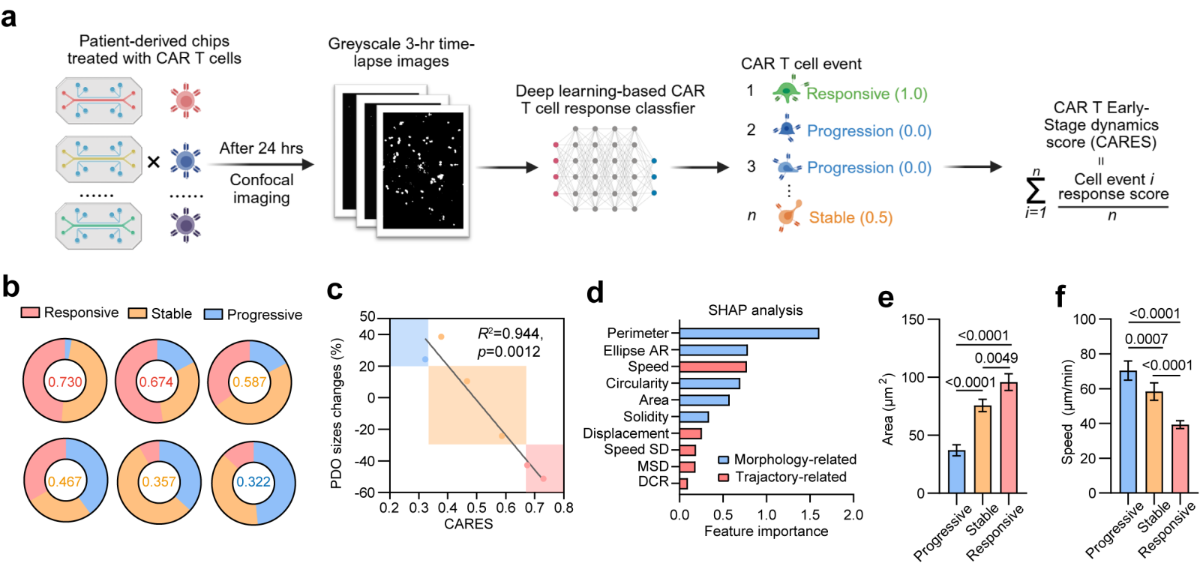
Fluorescence Microscopy of Patient-Derived Pancreatic Adenocarcinoma Organoids and SHAP Analysis of T-cell Dynamics and Antigen Expression
A project focused on applying explainable machine learning models to investigate critical features to patient recovery with immunotherapy. By learning more about the important features, we are then able to perform high-throughput immunotherapy drug screening and enable personalized drug recommendations for patients. This project used an multimodal Attention-LSTM model using T cell dynamics such as movement patterns and cell shape changes combined with antigen expression to classify T cells based on their activity pattern. Then, by applying SHAP to analyze the feature importance, we gained insight about what treatments work and why.
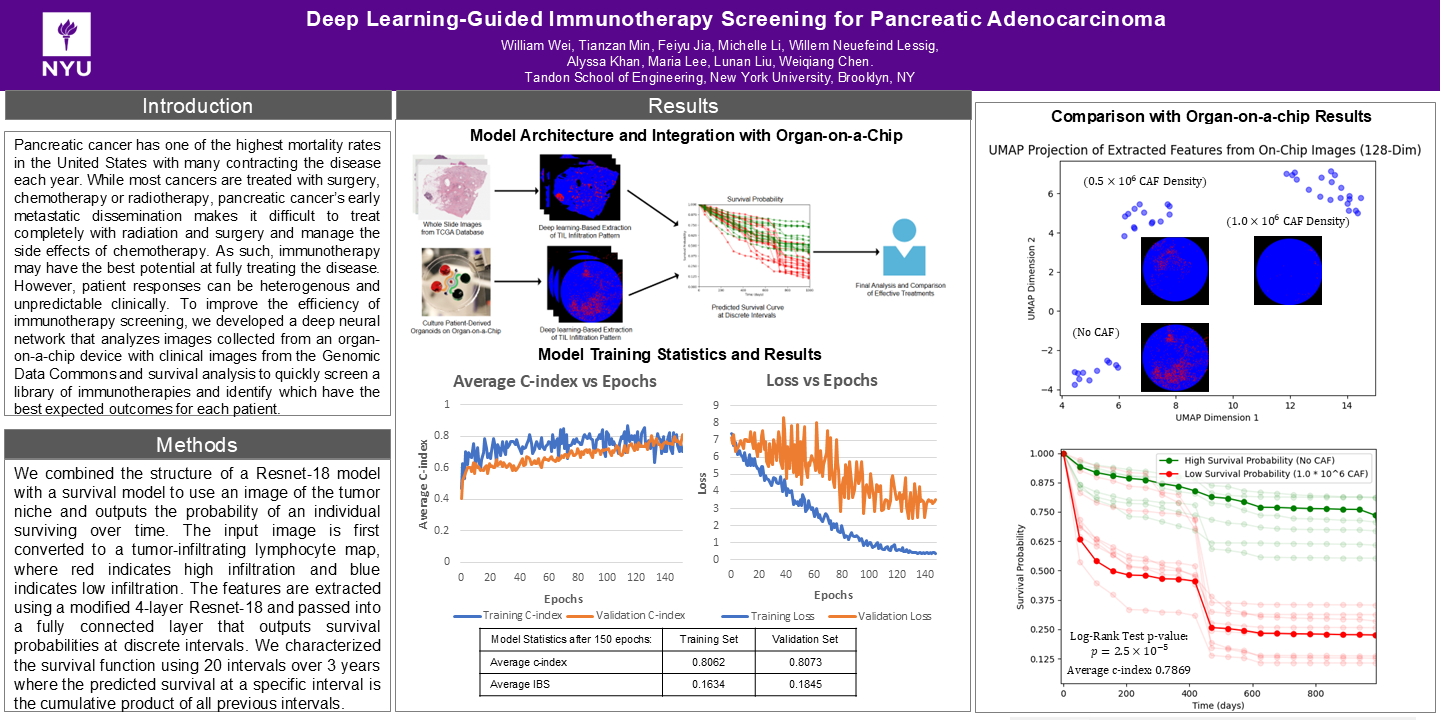
Deep Learning-Guided Immunotherapy Screening for Pancreatic Adenocarcinoma
A fine-tuned Resnet-18 model modified to H&E stains from the GDC Database of pancreatic adenocarcinoma to output a predicted survival curve based on the TIL infiltration pattern. This workflow supported a organ-on-a-chip device, this enabled rapid identification of patient responses and accelerated personalized drug screening.
Automated Crystal Tracking and Characterization With Machine Learning for Non-Photochemical Laser-induced Nucleation (NPLIN)
To expand the applications of non-photochemical laser-induced nucleation (NPLIN) while working in Professor Garetz's optics lab, I developed a deep learning model based on YOLO and U-Net to track crystals in real-time and perform pixel-level segmentation. We were then able to measure each crystal's size, shape and velocity, greatly reducing the analysis time of each experiment and opening possibilities for automated, real-time extraction of specific crystal clusters.
Cancer-on-a-chip for precision cancer medicine
A critical review that explores some of the reasons why preclinical models cannot recapitulate the complex tumor microenvironment (TME) and reflect the heterogeneity and patient specificity in human cancer and the future of Cancer on a Chip models(CoC). I provided an overview about how applying advanced artificial intelligence tools and computational models could exploit CoC-derived data and augment the analytical ability of CoC.
Liu, L., Wang, H., Chen, R., Song, Y., Wei, W., Baek, D., Gillin, M., Kurabayashi, K., & Chen, W. (2025). Cancer-on-a-chip for precision cancer medicine. Lab on a Chip, 25(14), 3314–3347. https://doi.org/10.1039/D4LC01043D
2D Tile-Based C++ Game Engine
A 2D top-down action game engine built with C++ and OpenGL, built for CS-3113 Introduction to Game Design. Features a scene-based architecture, tile map rendering, entity collision, enemy AI, and audio support.